The Complete Guide to Business Health Assessment for 2026
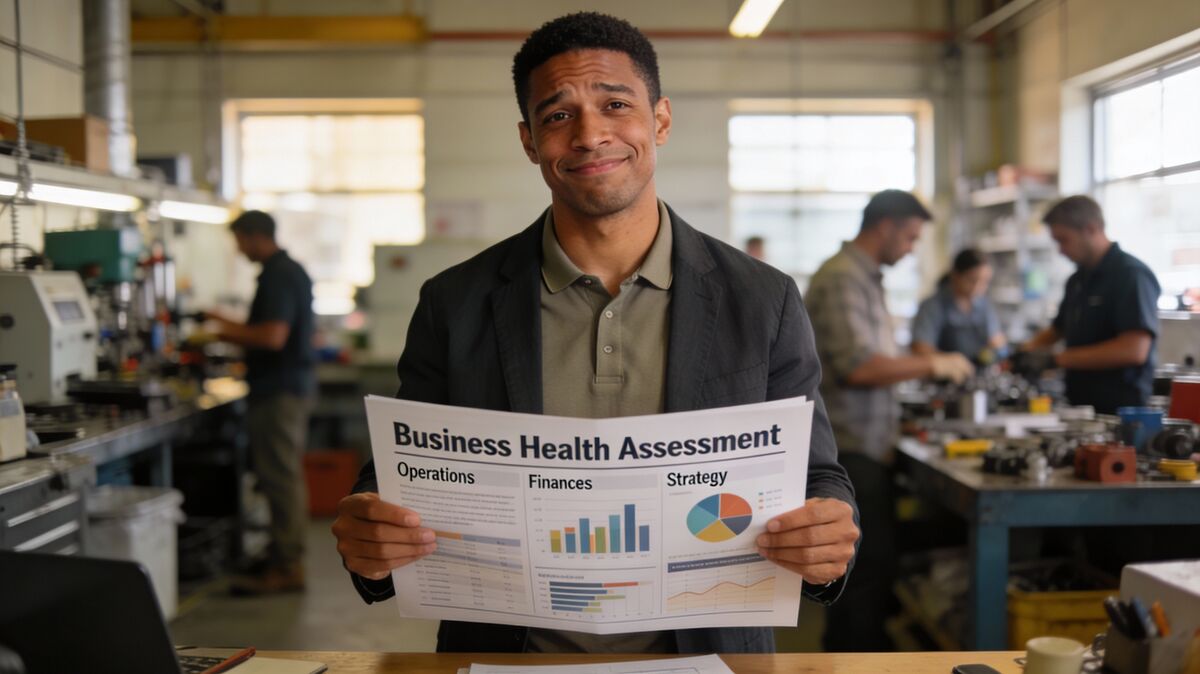
In 2026, small and mid-size business leaders find themselves at a pivotal moment. According to the latest Bank of America Business Owner Report, 74% of small business owners expect revenue increases in the coming year, and 60% plan to expand their businesses. That optimism is well-founded—but it's also conditional. The businesses that thrive in 2026 won't be those with the best intentions; they'll be those with the clearest understanding of where they actually stand.
That's where a Business Health Assessment becomes essential—not as an annual formality, but as the strategic foundation for everything you're planning to accomplish — including the kind of mindset reset we describe in happy new year 2026 — your year of growth.
Why 2026 Demands a Fresh Assessment
The business environment heading into 2026 has shifted in significant ways. Economic uncertainty remains a concern for 66% of small businesses, up from 48% last year. Inflation has settled into what analysts describe as a "semi-permanent condition" that will continue pressuring margins. Meanwhile, the transformation from experimental to operational AI adoption has accelerated—77% of business owners have now integrated AI into their operations, fundamentally changing competitive dynamics.
Yet within this complexity lies remarkable opportunity. Businesses that embrace smart technology are growing at significantly higher rates than peers who don't. Digital tool adoption—planned by 91% of business owners over the next five years—is democratizing capabilities that were once reserved for large enterprises. The question isn't whether to adapt, but whether you're building on a foundation strong enough to support that adaptation.
A Business Health Assessment answers that question with clarity. It reveals the cracks that could undermine your expansion plans, the hidden strengths you haven't fully leveraged, and the specific adjustments that will maximize your trajectory into the new year.
The Core Components of a Business Health Assessment for 2026
1. Financial Vital Signs: Reading the Real Story
Your financials tell a story, but the chapter that matters most for 2026 planning often isn't on the surface.
Start with cash flow—not just whether it's positive, but its patterns and timing. The Federal Reserve reports that 54% of small businesses cite uneven cash flow as a significant challenge. Understanding your cash conversion cycle—how long it takes to turn investments into collected revenue—determines your capacity to act on opportunities when they arise.
Dig deeper into profitability by segment. The 80/20 principle often applies: a minority of your offerings or clients may drive the majority of your profits, while others quietly consume resources without proportional return. Identifying this distribution is critical for allocating focus in 2026.
Examine your debt-to-equity ratio and working capital position. With interest rates elevated compared to the previous decade, the cost of leverage has real implications for growth financing. Businesses with clean balance sheets and stable margins will have strategic advantages in securing favorable terms—or operating without external capital at all.
Key metrics to benchmark:
- Cash conversion cycle (days)
- Gross and net profit margins by product/service line
- Customer profitability distribution
- Working capital adequacy for planned initiatives
- Debt service coverage ratio
2. Operational Efficiency: Finding Hidden Capacity
Inefficient processes are profit killers that become increasingly costly as your business grows. What works acceptably at one scale becomes untenable at the next.
Map your critical workflows from end to end. Where do handoffs create delays? Which tasks require manual intervention that could be automated? Where are your highest-paid team members spending time on activities that don't require their expertise? Applying Lean principles to these workflows can reveal that 40–50% of process steps add no customer value.
The operational efficiency imperative for 2026 is particularly acute. Research indicates that investments in automation and digital workflows can deliver up to 25% reduction in operational costs. With margin pressure persistent, that efficiency gap increasingly separates thriving businesses from struggling ones. Yet many owners operate without the business intelligence needed to see where these gaps exist.
Evaluate your technology stack honestly. Is it integrated, or do team members spend hours moving information between systems that should communicate automatically? Are you using tools designed for your current scale, or have you outgrown systems that once served you well? If your assessment surfaces meaningful gaps here, our guide to small business digital transformation without breaking what works walks through how to modernize in stages without disrupting the operations you depend on.
Areas to examine:
- Process cycle times versus industry benchmarks
- Manual task hours that could be automated
- Technology integration gaps creating duplicate data entry
- Resource allocation alignment with value creation
- Bottleneck identification and root cause analysis
Health Assessment
Ready to assess your business health across all dimensions?
Don't just read about business health—measure it. Our AI-powered diagnostic benchmarks your business across financial, operational, team, and strategic health in just 45 minutes.
No consultants. No ongoing fees. Just clarity.
3. Team and Culture: Your Competitive Foundation
Your people determine your capacity for everything you want to accomplish in 2026. Yet team health often receives less rigorous assessment than financial or operational metrics.
Current labor market dynamics make this assessment especially critical. The Bank of America report found that 61% of business owners are being impacted by labor shortages—with half personally working more hours to compensate. Retention isn't just a human resources concern; it's a strategic capability.
Assess employee engagement through direct feedback mechanisms—surveys, one-on-one conversations, skip-level meetings. Are your team members clear on priorities? Do they feel heard and valued? Is there trust in leadership?
Examine leadership effectiveness throughout your organization. Are managers empowering their teams or creating bottlenecks? Research shows that employees who feel micromanaged rather than developed are significantly more likely to disengage or leave.
Questions to explore:
- What is your annualized turnover rate, and how does it compare to your industry?
- Do employees understand and align with your company's strategic direction?
- Where do communication breakdowns most frequently occur?
- Are your managers developing their teams or just directing their work?
- What feedback channels exist, and are they actually used?
4. Strategic Alignment: Ensuring Focus Where It Matters
Daily operations can easily drift from strategic intent. The urgency of immediate demands crowds out the important work that determines long-term trajectory.
Evaluate whether your resource allocation—time, money, attention—actually reflects your stated priorities. If expanding your customer base is a top objective (47% of business owners cite this as a priority), what percentage of your resources is dedicated to that goal?
Conduct a fresh SWOT analysis through the lens of 2026's environment. Tariff implications, AI capability gaps, talent market dynamics, and evolving customer expectations all deserve consideration. What strengths position you to capitalize on emerging opportunities? What weaknesses require shoring up before you can scale?
Assess your readiness for the trends shaping the coming years: digital payment acceptance (priority for 52% of owners), workflow automation (47%), digital-first marketing (45%), and enhanced cybersecurity (30%). These aren't optional enhancements—they're increasingly table stakes.
Alignment checkpoints:
- Does current spending reflect stated strategic priorities?
- Are growth initiatives supported by adequate operational infrastructure?
- What market shifts require strategic response in the next 12 months?
- Is your competitive positioning sustainable given technology evolution?
- Do you have clear, measurable objectives for 2026?
Conducting Your Assessment: A Practical Roadmap
Ready to examine your business with fresh eyes as you prepare for 2026? Here's a structured approach that balances thoroughness with practicality:
Step 1: Gather Your Data Foundation (Week 1)
Assemble the information you'll need for honest assessment:
- •Financial statements from the trailing 12 months
- •Cash flow records with detailed timing visibility
- •Customer and product/service profitability analysis
- •Operational metrics: cycle times, productivity measures, capacity utilization
- •Employee feedback from existing surveys, exit interviews, or informal channels
- •Competitive intelligence and market trend data
Don't guess—verify. Assumptions that aren't grounded in actual data often mask the very issues your assessment should reveal.
Step 2: Engage Multiple Perspectives (Week 2)
Your view from leadership captures part of the picture, but not all of it. Involve stakeholders who see your business from different angles:
Host structured conversations with key team members across functions. What do they see that you might miss? Where do they experience friction that never reaches your attention?
Consider input from customers, suppliers, or advisors who interact with your business from the outside. Their perspective often reveals blind spots that internal views can't access.
Step 3: Analyze and Prioritize (Week 3)
Transform raw data into actionable intelligence:
Score each area of your business on both current health and strategic importance. A struggling function that's tangential to your 2026 priorities matters less than moderate weakness in a critical growth area.
Identify patterns across your assessment. Often, surface symptoms trace to deeper root causes—a cash flow problem might actually be a pricing problem or a customer concentration problem.
Prioritize ruthlessly. You can't address everything simultaneously, and attempting to will diffuse your energy. Select the high-leverage issues where focused attention will generate the greatest return.
Step 4: Build Your Action Plan (Week 4)
Convert insights into commitments:
For each priority issue, define specific actions, owners, and timelines. Vague intentions to "improve" don't create change; concrete next steps do.
Establish leading indicators that will show whether your interventions are working. Waiting until year-end to discover a strategy isn't performing wastes precious time — and a clear-eyed view of the most common small business strategic plan myths will keep you from confusing motion for progress while those indicators take shape.
Build quarterly review checkpoints into your calendar. The businesses that see assessment as an ongoing practice rather than an annual event catch problems earlier and capitalize on opportunities faster.
The DIY Advantage—And When to Go Further
Self-directed assessment offers genuine benefits. It deepens your personal connection with your business's reality. It builds internal capability for ongoing diagnosis. It often surfaces insights that only emerge through direct engagement with your own data and team.
For many business owners, this hands-on approach is the right starting point—especially for those who want to understand their business's health at a granular level before seeking external perspectives.
However, DIY assessment has inherent limitations. We all have blind spots about our own businesses. Patterns that would be obvious to an outside observer can remain invisible to those immersed in daily operations. Time constraints may prevent the depth of analysis that complex issues require. And benchmarking against industry norms is difficult without access to comparative data.
That's where leveraging proven tools like the BizHealth.ai Business Health Analyzer can deliver outsized value. Our AI-powered platform provides comprehensive diagnostic reports tailored specifically for micro, small, and mid-sized businesses—the analysis that would take weeks to compile manually, delivered in hours.
The platform identifies patterns across your financial health, operational efficiency, and strategic positioning that manual review might overlook. It benchmarks your performance against relevant comparisons, highlighting where you're strong and where attention is needed. It translates complex data into visual insights and specific recommendations you can act on immediately.
Users consistently report discovering hidden inefficiencies, profit leaks, and growth opportunities they hadn't recognized—insights that translate into 20-30% efficiency gains or meaningful profit improvements. The platform is designed for business leaders, not data scientists—accessible inputs, clear outputs, no steep learning curve.
Most importantly, it accelerates your path from assessment to action, freeing you to focus on what you do best: leading your business toward the future you envision.
Making 2026 Your Strongest Year
The businesses that thrive in the coming year will share a common characteristic: they'll know exactly where they stand and where they're going. They won't be surprised by problems that accurate assessment would have revealed. They won't miss opportunities that were hiding in plain sight.
A Business Health Assessment isn't about finding fault—it's about finding clarity. It's the foundation that makes confident decision-making possible, that transforms abstract goals into achievable plans, that gives you the visibility to navigate whatever 2026 brings.
The data is encouraging: business owner optimism is grounded in real performance, with 79% reporting stable or increased revenue over the past five years. The opportunity is genuine. The question is whether your business is healthy enough to seize it.
Start Your 2026 Planning Today
What's the one area of your business that keeps you up at night? Maybe it's a cash position that feels tighter than it should, a team dynamic that isn't clicking, or a growth ambition that current operations can't support.
A Business Health Assessment shines light on exactly those concerns—and shows you the path forward.
Take the first step: carve out time this month to honestly evaluate where your business stands. Use the framework above to structure your review. And when you're ready to go deeper, explore what the BizHealth.ai Business Health Analyzer can reveal about your business's potential.
You've built something worth growing. Let's make sure the foundation is ready for everything 2026 has in store.
Start Your BizHealth AssessmentFurther reading: Explore the shift from employee to owner mindset for a deeper look at this connected topic.
Further reading: See also our 2025 business health assessment overview for the prior-year framework.
Related Articles
Explore more insights to help grow your business

The Complete Guide to Business Health Assessment in 2025
A comprehensive guide to business health assessments—what they are, why they matter, and how they can transform your small business.

Financial Health Metrics Every Business Owner Should Track
Master the key financial indicators that predict business success and sustainability.

How to Confirm Business Weaknesses Without Hiring Consultants
A practical, AI-driven framework for surfacing the weaknesses holding your small business back—without a five-figure consulting engagement.

Small Business Blind Spots: 7 Critical Areas Owners Miss in 2025
The seven highest-impact blind spots we see across small business assessments, and how to systematically uncover them.
