E-Commerce Scaling in 2026: What Small Business Owners Need to Do Differently to Stay Competitive

In 2025, the competitive playbook for small business e-commerce was built around five disciplines: AI personalization, omnichannel presence, mobile optimization, subscription-based loyalty, and data-informed decision-making. Those five disciplines haven't become less important. They've become the floor — the minimum baseline that every serious online seller now operates from, including the large-platform competitors your business is measured against every time a potential customer opens a browser.
What's changed is the environment those disciplines operate in. The 2026 e-commerce landscape is structurally different from 2025 in ways that matter for how small businesses should be thinking about growth, channel strategy, customer ownership, and operational readiness. The platforms have matured. AI has moved from a competitive advantage to a competitive expectation. The cost of being average online has increased. And the businesses that scaled well in 2025 are now contending with a more sophisticated competitive field and more demanding customer expectations than they were 12 months ago.
This article is not a repeat of what worked in 2025. It is an honest assessment of what the e-commerce environment looks like right now, what has shifted, and what specific strategic adjustments small businesses need to make to continue scaling rather than plateauing in the more demanding competitive context of 2026.
The Ground Has Shifted: What's Different in 2026
Before diving into strategy, it's worth naming the specific ways the landscape has changed — because strategy built on last year's environment produces last year's results.
AI Is Now the Baseline, Not the Differentiator
In 2025, deploying AI-powered personalization was a competitive advantage for small businesses willing to adopt early. In 2026, the major platforms — Shopify, BigCommerce, Amazon, and all the significant marketplaces — have embedded AI personalization, recommendation engines, and customer behavior analysis as standard features. The question is no longer whether you use it — it's how intelligently you configure, train, and leverage it relative to your specific customer base and product category.
Agentic Commerce Is Emerging
AI shopping agents — tools that autonomously browse, compare, and purchase on behalf of consumers — are moving from concept to early commercial reality in 2026. Your product listings, pricing structure, and fulfillment reliability are now being evaluated not just by human shoppers but by AI intermediaries making purchasing decisions on their behalf. Small businesses that have not structured their product data to be machine-readable are increasingly invisible in this emerging discovery channel.
Marketplace Dependency Risk Has Become Critical
The businesses that scaled primarily through Amazon, Walmart Marketplace, or TikTok Shop in 2025 are discovering what always comes with platform dependency: fee increases, policy shifts, algorithm changes, and the structural reality that a customer who buys through a marketplace is the platform's customer, not yours. The data, the relationship, and the ability to re-engage are owned by the intermediary.
Customer Acquisition Costs Continue to Rise
Paid digital advertising has become more expensive as more competitors compete for the same attention inventory. The businesses that built their growth entirely on paid acquisition in 2025 are facing margin compression as customer acquisition costs increase faster than average order values. The sustainable e-commerce business in 2026 is one that has invested in channels that do not require paying for every customer every time.
Strategy 1: Own Your Customer Relationship — Before a Platform Does
The most consequential strategic shift a small business e-commerce operator can make in 2026 is the deliberate transition from platform-mediated customer relationships to direct, owned customer relationships. This is not about abandoning marketplaces — they remain valuable traffic and revenue channels — but about making the direct-to-consumer relationship the primary business asset rather than a secondary channel.
The distinction comes down to data. When a customer buys through Amazon, Amazon owns the customer relationship — the email address, the purchase history, the behavioral data. When the same customer buys through your own store, you own that relationship and everything it enables: the ability to re-engage without paying per impression, the ability to build genuine loyalty through direct communication, and the ability to understand your customer well enough to serve them better than a generic platform algorithm can.
What Owned Relationships Require
- •A direct-to-consumer channel compelling enough to attract and retain buyers
- •Email and SMS communication that delivers genuine value, not promotional noise
- •Discipline to consistently build first-party data through every transaction and interaction
"Each customer relationship you own is a relationship that can't be repriced, restricted, or revoked by a platform's next policy update."
Strategy 2: Move From Omnichannel Presence to Unified Commerce
In 2025, the goal was omnichannel presence — being available across multiple platforms and channels, with inventory synced and brand messaging consistent. That goal was right, and any small business that hasn't achieved it should still prioritize it. But the businesses that simply achieved presence in 2025 are discovering that presence without coherence creates operational complexity without proportionate customer benefit.
The 2026 standard is unified commerce — a step beyond omnichannel that integrates not just inventory and brand identity across channels, but the entire customer experience, data, and relationship. In unified commerce, a customer who discovers you on TikTok, adds to cart on mobile, completes checkout on desktop, and contacts support through Instagram receives a single, coherent experience that reflects their full history with your brand — not a series of disconnected interactions that each behave as if the customer is new.
Operational Reality: Every new channel managed through a separate system, with separate customer data, separate inventory tracking, and separate analytics is a channel that adds cost and complexity without building the kind of cohesive customer experience that drives loyalty in a more competitive market.
The right question in 2026 is not "which channels should we add?" but "how do we connect our existing channels so that the customer experience is genuinely unified and our operational view is genuinely complete?" That question produces a different set of decisions — and a more sustainable competitive position.
E-Commerce Health Check
Is Your Online Business Ready for 2026?
Get a comprehensive assessment of your e-commerce operations, from channel strategy to fulfillment readiness — in under 45 minutes.
No consultants. No ongoing fees. Just clarity.
Strategy 3: Build a Post-Paid-Acquisition Growth Engine
The businesses that will outperform in 2026 e-commerce are the ones that have reduced their dependence on paid advertising as the primary driver of new customer acquisition. Not because paid channels are ineffective — they still work — but because a business model that requires continuous paid investment to generate each new customer is a business model with a structural ceiling on profitability and scaling capacity.
The alternative is building what sustainable e-commerce businesses rely on: organic discovery, word-of-mouth, community, and the compounding effect of genuine customer loyalty. Each of these is harder to build than a paid campaign and more durable than any single advertising platform. Each produces customers who arrive with lower acquisition cost and higher lifetime value than their paid-channel counterparts.
Content-Driven Discovery
Specific, authoritative, problem-solving content that positions your business as the answer to questions your ideal customer is already asking — in search, on social, and through AI-driven shopping queries.
Referral-Powered Acquisition
Building referral mechanisms that activate your existing customers as an acquisition channel — a referred customer costs a fraction of what a paid customer costs and converts at a meaningfully higher rate.
Experience-Driven Word-of-Mouth
The kind of service quality, personalization, and post-purchase experience that makes a customer want to tell someone. Memorable experiences are not a soft outcome — they are a measurable acquisition strategy.
Community Building
Creating genuine belonging rather than transactional touchpoints — communities that generate organic advocacy and reduce your dependence on the advertising platforms that control your access to attention.
Strategy 4: Make Your Product Data Work in an AI-Driven Discovery World
One of the most underappreciated operational priorities for small business e-commerce in 2026 is the quality and structure of product data. As AI-powered shopping agents, voice search, and AI-mediated search results increasingly influence how products are discovered and purchased, the businesses with clean, rich, well-structured product information will surface in those channels. The businesses with thin, inconsistent, or poorly structured product data will be invisible in them.
This is a meaningful shift from the 2025 SEO environment, where optimization was primarily about keyword placement in human-readable content. In 2026, the additional layer is machine-readability — structured product attributes, accurate categorization, detailed specifications, and consistent data formatting that AI discovery tools can parse, compare, and recommend from reliably.
Product Data as a Strategic Asset
- Complete attributes and specific language reflecting how buyers actually search
- Multiple quality images with descriptive alt text
- Structured data markup for AI system context
- Accurate categorization and detailed specifications
- Consistent data formatting across all listings
"Treating product data as a strategic asset rather than an administrative task is one of the highest-leverage improvements available to small business e-commerce operators in 2026 — and one of the most consistently neglected."
Strategy 5: Convert Loyalty From a Program Into a Value Experience
The subscription and loyalty models that drove customer retention in 2025 are facing a maturity problem in 2026: they've become ubiquitous. "Subscribe & Save" discounts, points programs, and email drip sequences are now standard features of most e-commerce stores, which means they've lost much of their differentiation value. A loyalty program that looks and feels like every other loyalty program doesn't create loyalty — it creates another inbox notification to ignore.
The loyalty strategy that actually drives retention in 2026 is one built around genuine value creation rather than discount mechanics. This means understanding what your specific customer base values beyond price — the expertise, the community, the curation, the service quality, the trust — and building a post-purchase experience that delivers on those dimensions consistently.
For small businesses, this is an area of genuine competitive advantage. Large platforms are structurally optimized for transaction volume, not relationship depth. The small business that knows its customer well enough to deliver personally relevant post-purchase communication, proactive service, and a community experience that feels like belonging rather than marketing is building a loyalty moat that no discount structure can replicate.
The practical work is understanding, honestly and specifically, why your best customers keep coming back — not in general terms, but in the specific language they would use. That understanding is the foundation of a loyalty experience rather than a loyalty program, and it is the thing that converts repeat purchase into genuine advocacy.
Strategy 6: Build Operational Infrastructure Before You Need It
Every successful e-commerce scaling story eventually confronts the same operational reality: the systems, workflows, and team capacity that supported the business at its previous size are insufficient for the demands of the next size. The businesses that navigate this reality well are the ones that built operational infrastructure proactively — before scale exposed the gaps — rather than reactively in the middle of a growth period when the cost and disruption of change are highest.
Order Fulfillment
Consistency at higher volume without quality degradation
Customer Service
Capacity during growth-driven demand increases
Inventory Forecasting
Procurement accuracy as SKU and channel count expand
Financial Management
Accuracy and visibility as transaction complexity grows
"At twice your current order volume, which of your current operational systems would break first — and are you addressing it before you get there or after?"
Understanding where your operational gaps are — across fulfillment, technology, team structure, financial management, and customer experience — before you accelerate growth is the work that separates e-commerce businesses that scale well from the ones that scale and break. Tools like BizHealth.ai assess operational readiness across every dimension of business health, giving e-commerce owners a clear picture of where their infrastructure can support the growth they're pursuing and where it will create the friction that slows or reverses it.
What 2026 Rewards
The through-line across every strategic shift that matters in 2026 is a move away from tactics and toward fundamentals — away from platform dependency and toward owned relationships, away from paid acquisition and toward earned discovery, away from omnichannel presence and toward unified experience, away from loyalty programs and toward loyalty value, away from reactive operations and toward proactive infrastructure.
The businesses that outperform in 2026 e-commerce will not be the ones that found the best hack or identified the least-crowded platform. They will be the ones that made the harder investments in the things that compound — customer relationships that are owned and deepened, product data that surfaces consistently in an AI-mediated discovery environment, operational systems that can sustain growth without the owner becoming the critical bottleneck, and a brand identity specific and compelling enough that customers choose it rather than merely land on it.
The 2025 playbook was about being present across channels and using available tools. The 2026 playbook is about being genuinely excellent within a strategy that is built to last — one where each investment in relationship, data, and operations produces returns that build on each other rather than requiring continuous reinvestment just to maintain position. That is not a harder goal than what 2025 required. In most respects, it is the same work — done with more discipline, more strategic clarity, and a longer time horizon than the year of chasing channels and growth hacks that many small businesses are now outgrowing.
Where BizHealth.ai Fits
Whether you're scaling your e-commerce operations, building owned customer relationships, or preparing your infrastructure for growth — BizHealth.ai assesses your business across all 12 critical health areas. Get actionable insights in 30–40 minutes, no subscription required.
Get Your Business Health AssessmentFrequently Asked Questions
What's the biggest e-commerce mistake small businesses make in 2026?
Relying on a single marketplace for the majority of revenue without building direct customer relationships. Platform dependency creates strategic vulnerability — when the platform changes fees, algorithms, or policies, your entire business model is at risk.
How is unified commerce different from omnichannel?
Omnichannel means being present on multiple platforms. Unified commerce means those platforms share the same customer data, inventory, and experience — so a customer's journey feels coherent regardless of where they interact with your brand.
How do I prepare my product data for AI shopping agents?
Focus on structured data markup, complete product attributes, specific and natural language descriptions, multiple quality images, and consistent data formatting. AI agents parse structured information — thin or inconsistent listings become invisible.
Can small businesses really compete with paid acquisition costs rising?
Yes — by reducing dependence on paid channels. Invest in organic content, referral programs, community building, and post-purchase experiences that generate word-of-mouth. These channels produce customers with lower acquisition costs and higher lifetime value.

BizHealth.ai Research Team
Expert analysis and actionable insights for small business owners navigating growth, profitability, and operational excellence.
Research from the Shopify Commerce Trends Report confirms that the shift toward unified commerce and first-party data ownership is reshaping how successful e-commerce businesses operate in 2026.
Related Articles
Explore more insights to help grow your business
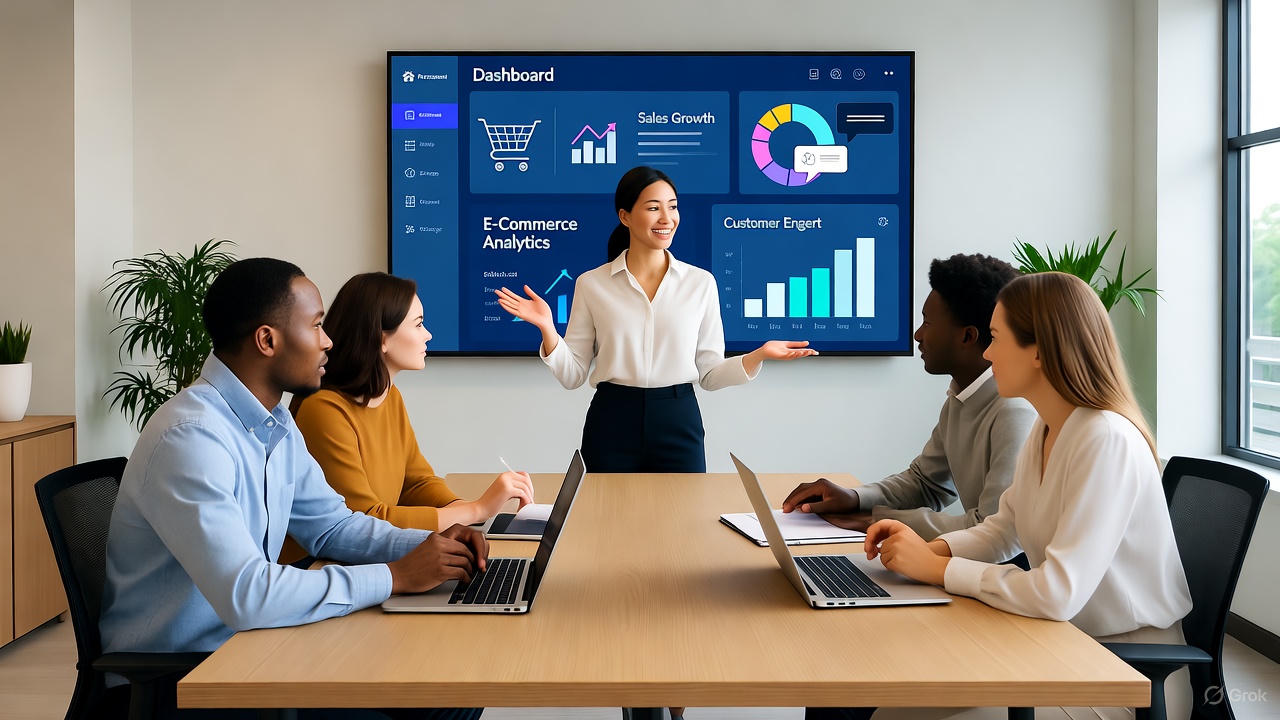
E-Commerce Scaling: 5 Strategies for SMBs Thriving in 2025
The foundational 2025 playbook that set the stage — AI personalization, omnichannel presence, and data-driven decisions.

Ready to Scale or Ready to Break? The Small Business Owner's Honest Guide to Expanding Into New Markets
Scaling is a stress test of every system your business has built. Learn when you're truly ready.
Customer Loyalty Starts with Reliability: The Invisible Engine Behind Repeat Business
Build the kind of loyalty that survives competition by operationalizing reliability into every customer touchpoint.
