
Family Business Success: How to Prevent Family Dynamics from Undermining Your Company's Growth and Culture

Family-owned and family-operated businesses represent one of the most enduring and admirable forms of enterprise in the American economy. The shared sacrifice that built them. The generational knowledge embedded in their operations. The trust, commitment, and personal investment that family members bring to the work in ways that hired employees rarely replicate. The pride of ownership that shows up in the quality of the product, the consistency of the service, and the relationship with the community the business serves.
These are real advantages — and they are not trivial ones. Many of the most successful, most respected, and most resilient small businesses in existence are family operations, and the family dimension of how they are run is a genuine part of what makes them excellent.
But family-operated businesses also carry a structural dynamic that no other business type faces in the same way — and that, left unaddressed, has the potential to quietly erode the culture, the performance, and the growth capacity of even the most well-intentioned operation.
The core dynamic, stated plainly:
The family does not stop being a family when it walks through the business door. The relationships, the history, the tensions, the loyalties, the unspoken expectations, and the emotional weight of decades of shared experience do not park themselves in the lot and wait. They come inside. They sit in the meetings. They influence the decisions. They shape who gets heard, who gets opportunities, who gets held accountable, and who does not.
And when those dynamics are allowed to operate without the structure, the clarity, and the deliberate management that a professional business environment requires, they do not just affect the family. They affect every non-family employee in the organization — in ways that damage morale, undermine engagement, create retention problems, and limit the business's ability to attract and keep the talent it needs to grow.
This article is about understanding those dynamics honestly, recognizing when they are actively hurting the business, and deploying the specific strategies that allow family-operated businesses to capture the genuine advantages of family ownership without paying the organizational cost of unmanaged family dynamics.
The Structural Reality: Where Family Dynamics Fill the Void
To understand how family dynamics become a business problem, it helps to understand the specific mechanism through which they operate — because it is not random, and it is not inevitable. It is structural.
In any business, there are two forces that govern how decisions get made, how people are treated, and how conflicts get resolved: formal business processes and informal relationship dynamics. In a well-structured business, formal processes — clear roles, documented expectations, consistent accountability, transparent decision-making — govern the majority of operational decisions. Informal dynamics exist, as they do in every human organization, but they operate within a framework that limits their ability to produce outcomes inconsistent with what the business actually needs.
In a family-operated business where formal processes are underdeveloped — where roles are assumed rather than defined, where accountability is applied inconsistently, where decision-making authority is unclear, and where performance standards are informal — that structural void does not stay empty. It gets filled. And in a family business, what fills it is family dynamics.
The unwritten rule about how to handle a disagreement with the owner's son-in-law. The understood reality that certain decisions go to the founding generation regardless of the organizational chart. The informal consensus that some family members' ideas get more airtime in meetings than others', independent of their merit. The unspoken awareness of which mistakes get addressed and which get quietly absorbed because of who made them.
Non-family employees observe all of this — often more clearly and more accurately than the family members themselves. And what they observe shapes their conclusions about the business: whether it is a place where performance matters, where their contribution is genuinely valued, where they have a real opportunity to advance, and whether the organization they are investing their professional energy in is one they can trust to be fair.
When those conclusions turn negative — and they turn negative faster than most family business leaders realize — the consequences are specific and expensive: disengagement, reduced discretionary effort, departure of the best performers who have the most options, and the quiet cultural deterioration that precedes the talent problems that eventually become impossible to ignore.
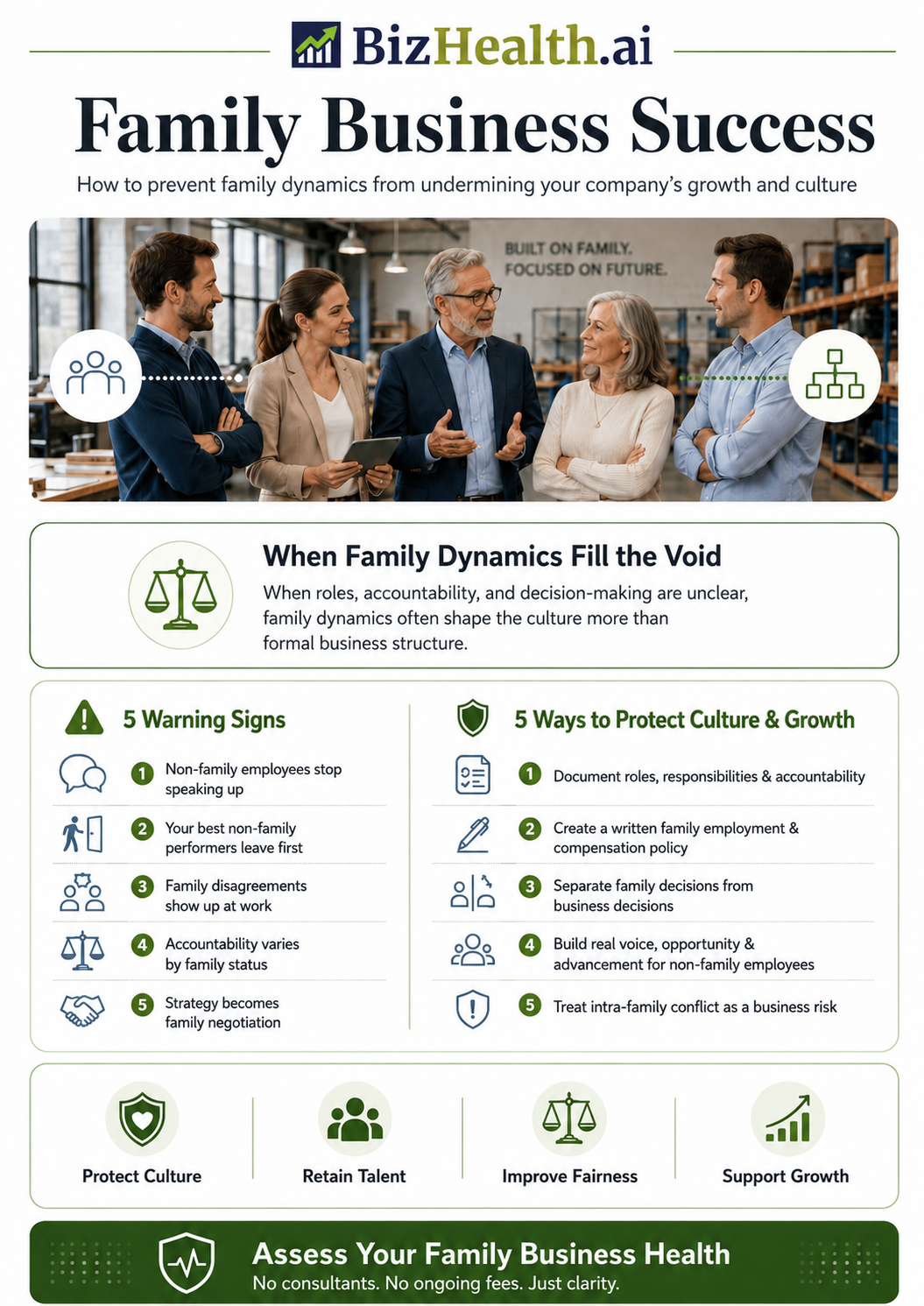
How to Identify When Family Dynamics Are Actively Hurting the Business
The first challenge in addressing the negative impact of family dynamics is recognizing that it is happening — because the signals are often subtle, cumulative, and easy to attribute to other causes. The owner who is closely embedded in the family relationships that are creating the dynamics is frequently the last person to see them clearly.
Here are the most reliable indicators that family dynamics have crossed from background context into active business liability:
Non-Family Employees Stop Offering Ideas or Raising Concerns
When a team member who was previously engaged and contributive becomes quiet in meetings, stops offering suggestions, and routes all concerns through informal conversations rather than direct dialogue with leadership, it is rarely because they have run out of ideas. It is because they have concluded that their input does not carry real weight in a decision environment that is shaped by family relationships rather than merit.
The most telling version of this signal is the absence of productive friction — the complete smoothness of meetings where no one pushes back, no one questions assumptions, and every idea from family leadership is received without challenge. That smoothness is not harmony. It is withdrawal. And withdrawal in a team that was previously engaged is one of the clearest early signals that the business's culture has shifted in a direction that non-family employees have noticed and have decided not to fight.
Your Best Non-Family Performers Are the First to Leave
Voluntary turnover in family businesses follows a predictable and painful pattern: the employees with the most skill, the most professional options, and the highest standards for workplace fairness are consistently the first to leave when family dynamics have made the culture feel inequitable. They leave not because the pay is insufficient or the work is uninteresting, but because they have an accurate read on a fundamental truth: in a business where advancement, recognition, and accountability depend more on family relationship than on performance, they have a ceiling that no amount of excellent work will raise.
When the employees who are leaving are the ones you most need to retain — and when exit conversations, if held honestly, reveal themes of favoritism, inconsistent standards, or the sense that the business is run for the family rather than by it — the retention problem is not a compensation problem. It is a culture problem with family dynamics at its root.
Family Disagreements Outside the Business Appear Inside It
The argument at Thanksgiving that produces two weeks of cool formality between two family members who work together. The ongoing tension between siblings about the direction of the business that began as a genuine strategic disagreement and has calcified into a positional conflict that disrupts every meeting it enters. The founding generation's difficulty relinquishing decision-making authority to the next generation, producing a subtle but organizationally damaging power dynamic that plays out in front of the entire team.
When non-family employees begin commenting — directly or indirectly — on the tension between family members, when they adjust their own behavior based on what they perceive the current state of intra-family relationships to be, or when operational decisions are visibly being driven by family dynamics rather than business logic, the boundary between the family and the business has been lost. And that boundary, once lost, requires deliberate structural effort to restore.
Accountability Is Applied Inconsistently by Family Status
This is the signal that damages non-family employee morale most reliably and most severely. When a non-family employee and a family employee make comparable mistakes or produce comparable performance failures — and the non-family employee faces a clear accountability conversation while the family member's situation is handled privately, minimized, or quietly absorbed — every employee who observes that difference draws the same conclusion: the rules here apply differently depending on who you are.
That conclusion is not easily reversed by a subsequent demonstration of fairness. It becomes the lens through which subsequent events are interpreted. And once the lens is in place, the burden of proof for demonstrating genuine fairness is high — because the employees are no longer evaluating individual events. They are looking for confirmation of a pattern they believe they have already identified.
Strategic Discussions Become Family Negotiations
When the business's most important strategic conversations — about direction, investment, growth, and structure — are effectively determined by intra-family relationship dynamics rather than the quality of the analysis, the business has lost something critical: the ability to make decisions in its own best interest rather than in the interest of managing family relationships.
The family business that cannot pursue a clearly superior strategic option because one family member objects for reasons that are personal rather than analytical. The one that continues a practice that the data clearly suggests should change because changing it would require a difficult conversation with a family member who owns the current approach. The one that promotes a family member into a role they are not ready for because the alternative would create family conflict — these are the decisions that quietly limit the business's competitive capability and signal to non-family leadership that their analytical contribution to strategy has limits that family politics imposes.
Culture Diagnostic
Is your family business culture working — or quietly costing you your best people?
The signals are usually visible long before the turnover starts. A structured business health assessment surfaces the organizational gaps that family-focused internal perspectives tend to normalize or miss entirely.
No consultants. No ongoing fees. Just clarity.
The 5 Best Ways to Counterbalance Family Dynamics Negatively Impacting Your Business
The strategies that most effectively protect a family-operated business from the negative impact of family dynamics share a common principle: they replace the informal, relationship-governed norms that family dynamics exploit with formal, clearly documented, consistently applied business structures that make the rules of the organization independent of who is related to whom.
| Jump | Strategy | What It Replaces |
|---|---|---|
| 1 | Documented roles & accountability for every position — including family | Assumed roles and selective accountability |
| 2 | Written family employment & compensation policy | Informal hiring and opaque family pay |
| 3 | Governance that separates family decisions from business decisions | Decisions made at the dinner table |
| 4 | Genuine voice, visible opportunity & advancement for non-family employees | A ceiling defined by last name |
| 5 | Treat intra-family conflict as a business risk, not a personal matter | “They'll work it out at home” |
Tap any number to jump directly to that strategy.
Strategy 1: Establish and Enforce Documented Roles, Responsibilities, and Accountability Standards for Every Position — Including Family Members
The single most powerful structural protection a family business can build is the same one that resolves the foundational mechanism described earlier: replacing the void that family dynamics fill with documented, enforced business process.
This means every position in the business — including positions held by family members — has a documented job description with clear responsibilities, defined performance expectations, and an identified accountability structure. Not the informal understanding that everyone is doing their part. The formal, written clarity that makes performance objectively evaluable rather than subjectively managed through the filter of family relationship.
The accountability structure for family member employees is the most critical and most frequently avoided dimension of this strategy. When family members are held to the same performance standards, reviewed through the same processes, and receive the same consequences for performance failures as non-family employees — and when the entire organization can observe that this consistency is real — the most damaging signal in family business culture is neutralized. The rules apply to everyone. The family relationship does not confer exemption from the professional expectations of the business.
The honest reframe most family businesses need:
A family member who is not performing in their role is not just an employment problem — they are a culture problem. Every non-family employee who observes unaddressed underperformance by a family member recalibrates their own investment in the organization accordingly. Addressing it is difficult. Not addressing it is more expensive.
For a deeper look at how role clarity becomes the operating backbone of a scalable team, see our companion guide on R2A2 job descriptions and role clarity for small business teams.
Strategy 2: Create a Family Employment and Compensation Policy — Written, Communicated, and Applied Before the Next Family Member Joins
Most family businesses do not have a formal family employment policy. Family members join the business because they are family, take on roles that are defined by need and availability rather than qualification and organizational design, and are compensated through a combination of formal salary and informal family-related considerations that are rarely transparent to the broader organization.
This informality creates the perception of privilege — often accurately — and that perception is one of the most corrosive elements in family business culture for non-family employees.
A formal family employment policy addresses this directly. It establishes, in writing, the standards and processes that govern how family members enter the business, what qualifications are required for specific roles, how compensation is determined (using the same market-rate benchmarking applied to non-family positions), and what the expectations and consequences are for performance. It communicates to the organization — including prospective non-family talent — that family membership is not a hiring criterion or a compensation advantage. It is simply a descriptor of a relationship that exists outside the business's professional environment.
The policy is most credible when it is established before it is needed — before the next family member is considering joining — rather than in response to an existing situation that has already created organizational tension. A retroactively applied policy carries the appearance of management. A proactively established policy carries the appearance of principle. The difference in how the organization receives it is significant.
Strategy 3: Establish a Formal Governance Structure That Separates Family Decisions from Business Decisions
One of the most reliable sources of organizational disruption in family businesses is the absence of a clear separation between decisions that belong to the family and decisions that belong to the business. When family conversations about ownership, succession, compensation, and business direction happen informally — at family dinners, in side conversations between family members, in the car on the way to a client meeting — and then appear in the business environment as already-decided positions rather than deliberated outcomes, the non-family leadership team is left in the position of implementing conclusions they had no meaningful input into.
A formal governance structure — even a lightweight one appropriate for a small business — creates the separation that prevents this dynamic. At its simplest, this means:
A regular family meeting
Specifically addresses family ownership matters, succession considerations, compensation structures for family members, and the family's collective vision for the business — with a defined agenda, documented outcomes, and a clear understanding that these conversations happen here, not in the business.
A regular business leadership meeting
Addresses operational direction, team performance, strategic priorities, and business decisions — attended by relevant business leaders (which may include family members in their business roles, but not in their family roles), with decision authority based on organizational responsibility rather than family relationship.
The separation is not about excluding family from business. Family members who hold meaningful business roles should absolutely be central to business leadership. It is about creating the clarity that allows both the family and the non-family leadership to know what kind of conversation they are in — and to trust that business decisions are made by the business, not by the family.
Strategy 4: Build a Leadership Culture Where Non-Family Employees Have Genuine Voice, Visible Opportunity, and Meaningful Advancement
The most talented non-family employees will not stay in a family business indefinitely if they cannot see a credible path to meaningful leadership contribution and advancement that is genuinely accessible to them. This is the specific retention challenge that family businesses face more acutely than any other business structure — and it is the one that requires the most intentional leadership investment to address.
Building genuine opportunity for non-family employees requires more than the stated intention to promote based on merit. It requires the visible, consistent reality of non-family employees being given meaningful leadership responsibilities, being included in significant business discussions, having their input actioned rather than acknowledged and dismissed, and advancing into senior roles when their performance warrants it — regardless of the family's size or the number of roles family members might theoretically fill.
The non-family employee who watches a family member step into a senior role they were more qualified for does not file a formal complaint. They update their resume. Preventing that outcome does not require excluding qualified family members from advancement. It requires the organizational credibility — built through consistent, observable behavior over time — that advancement in this business is genuinely available to whoever earns it.
One of the most effective structural tools for building this credibility is the use of external advisory input — whether through a formal advisory board, a business health assessment, or an experienced outside advisor — to provide the independent voice in strategic and organizational decisions that non-family leaders can see and trust is not filtered through family dynamics. When non-family employees observe that the business takes outside perspective seriously and holds its own assumptions accountable to external standards, the organizational culture communicates something important: that the business is run as a business, and that merit — not family membership — is the operative currency.
Strategy 5: Address Intra-Family Conflict as a Business Risk, Not Just a Personal Matter
When family members who work together are in conflict — whether the conflict originated in the business or in the family — the tendency in most family businesses is to treat it as a personal matter that the individuals involved need to resolve privately. This instinct is understandable. It is also, from a business leadership perspective, incomplete.
Intra-family conflict that bleeds into the business environment is not a personal matter for the employees who work in that environment. It is a culture condition — one that affects how safe people feel speaking honestly, how willing they are to raise concerns, how much psychological energy they spend managing around the conflict rather than investing in their work, and how much confidence they have in the business's leadership stability.
The business leader's responsibility — whether they are the founder, the CEO, or the senior family member with organizational authority — is to address intra-family workplace conflict with the same directness, the same sense of urgency, and the same accountability framework that would be applied to any other significant leadership behavior that is damaging the organizational environment. Not as an intrusion into personal relationships, but as the exercise of organizational responsibility: the people who work here deserve a professional environment where the leadership's personal relationships do not create the working conditions.
In practice, this often requires external facilitation — a business coach, a family business consultant, or a mediator experienced in family business dynamics — because the internal relationships that created the conflict are rarely capable of resolving it without structural assistance. Investing in that facilitation is not an admission that the family cannot get along. It is the recognition that professional mediation of professional conflicts is a business leadership best practice, regardless of the organizational structure it occurs within.
The Business Health Dimension: What Family Dynamics Do to the Numbers
The impact of unmanaged family dynamics in a business is not limited to the cultural and relational dimensions described above. It shows up in the metrics — often in ways that the business tracks without identifying the root cause.
- Turnover rates that are above the industry norm, particularly for mid-level and senior non-family employees.
- Engagement scores — if the business measures them — that reflect the disengagement of team members who are present but not invested.
- Productivity metrics that reflect a workforce managing around interpersonal dynamics rather than focusing on the work.
- Recruiting challenges that emerge when the business's reputation in the local talent market has been shaped by the stories that former employees carry with them.
These are not soft costs. They are real financial impacts — in recruiting expenses, in onboarding investment for replacements, in the productivity gap of a team that is performing below its potential, and in the opportunity cost of the innovation, the initiative, and the contribution that disengaged employees are not providing. Research from the Society for Human Resource Management (SHRM) consistently confirms that voluntary turnover among high performers is one of the most expensive and underestimated drains on small business profitability.
Understanding the specific health of the organizational and cultural dimensions of a family business — and the degree to which family dynamics are affecting those dimensions — requires the kind of honest, external, diagnostic perspective that the business's internal relationships cannot provide neutrally. Platforms like BizHealth.ai's business diagnostic process provide exactly this kind of comprehensive business health assessment, surfacing the organizational and operational gaps that family-focused internal perspectives tend to normalize or miss entirely.
The Family Business Advantage, Protected
The goal of everything in this article is not to make a family business less of a family business. It is to make the family business more capable of protecting and deploying the genuine advantages that family ownership provides — the commitment, the trust, the continuity, the shared purpose — without paying the organizational cost of allowing family dynamics to govern what business processes should.
The family businesses that do this well share a consistent orientation: they treat the business as a professional organization that happens to be owned by a family, rather than a family operation that happens to be a business. That distinction — in how roles are defined, how accountability is applied, how decisions are made, and how non-family employees are treated — is the difference between a family business that attracts excellent people and builds a high-performance culture and one that is perpetually constrained by the dynamics it never found a way to separate from the operation.
The advantage of the family business — the loyalty, the long-term thinking, the deep institutional knowledge, the personal investment — is worth protecting. And the way to protect it is to build the professional structure that allows it to express itself without the dynamics that undermine it.
That is not a compromise of what makes a family business special. It is the discipline that makes the special parts sustainable.
Get an Honest, Outside Read on Your Family Business
See exactly where family dynamics are quietly affecting culture, retention, and growth — and which structural changes will protect the family business advantage. Built for small business owners. No consultant fees.

Expert Insights from the BizHealth.ai Research Team
Family business operations, governance & organizational development
Our team combines decades of experience in family business consulting, organizational development, and small business operations to deliver actionable insights for owners navigating the unique structural realities of family-run companies.
Related Articles
Explore more insights to help grow your business

When Family Gets in the Way of Business: How to Stop Nepotism and Favoritism From Destroying Your Company
Family dynamics fill the vacuum left by missing systems. Learn the 7 steps to professionalize while preserving family values.
Stop Blaming the Labor Market: Your Employee Turnover Problem Starts in the Mirror
Turnover is rarely a labor-market problem. It's almost always a leadership and culture problem — and family dynamics make it worse.

R2A2 Job Descriptions: Role Clarity for Small Business Teams
The role-clarity framework that makes accountability objective — for family and non-family employees alike.