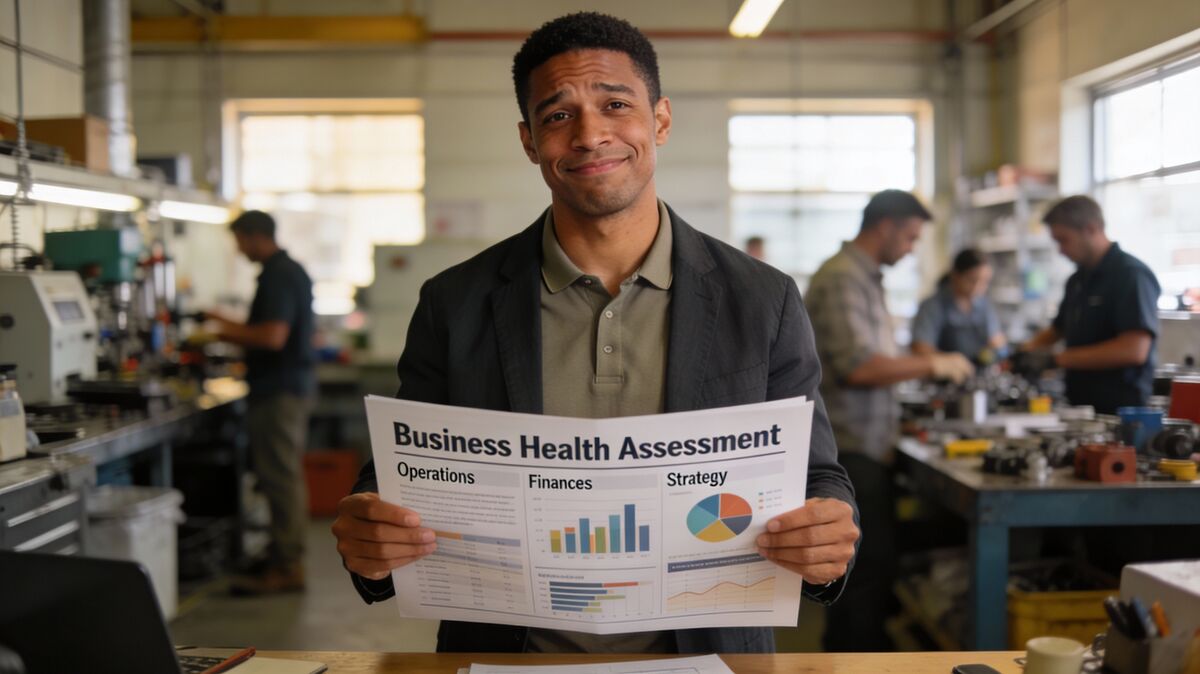
In today's data-saturated world, small business leaders are bombarded with "one-size-fits-all" guidance: "Optimize your supply chain" or "Boost customer retention." While well-intentioned, this generic info lacks the specificity to address your business's quirks—be it a niche retail operation in Chicago or a tech startup in Sydney. Result? You read, nod, and file it away, but nothing changes. Studies show that 70% of small businesses cite cash flow challenges and operational gaps as top challenges, yet broad advice rarely equips you to tackle them head-on. Most of these assumptions mask the six operational blind spots that cost small businesses $50K or more annually — invisible until someone looks systematically.
Your business is unique: It boasts incredible strengths—like agile decision-making or loyal teams—but also harbors gaps, perhaps more than you'd admit. That's normal for growing ventures, especially those with 1-500 employees and $100K-$50M revenue. The issue? Without a deep, honest look, you're operating on assumptions. Guessing at solutions wastes time and resources, perpetuating cycles of frustration. True progress demands insights that pinpoint exactly what your business is (and isn't), measuring it against competitors, industry benchmarks, and peers.
This is where impact enters: Specific diagnostics reveal not just problems, but prioritized paths forward. Imagine knowing your operational efficiency lags 20% behind similar firms—then getting tailored steps to close that gap. That's the meter-mover: From insight to action, fostering lasting change that aligns with your mission to scale sustainably.
Why Generic Advice Fails
It skips diagnosis and goes straight to prescription. A doctor who prescribes medication without examining the patient is practicing malpractice. A business article that says "optimize your supply chain" without knowing whether your business has a supply chain problem, a demand forecasting problem, a vendor concentration problem, or a pricing problem is doing the business equivalent — it's why Lean principles start with mapping the actual process, not assuming what's broken. Generic advice is prescription without diagnosis — and acting on it wastes money, time, and leadership credibility. The most dangerous outcome isn't that the advice is wrong. It's that it's partially right — just enough to feel productive, never enough to create lasting change.
It averages across businesses that are nothing alike. When an industry report says "small businesses should aim for a 15% operating margin," that number is the average of a technology services firm running 40% margins and a restaurant running 5% margins. The average is statistically accurate and operationally useless for either business. Your business doesn't operate at the average — it operates at its specific intersection of industry, model, team, geography, and growth stage. Benchmarking against the average is the equivalent of setting your thermostat to the global mean temperature. It tells you nothing about whether your building is too hot.
It creates confirmation bias, not clarity. The most insidious effect of generic advice is that business owners find the piece of advice that validates what they already believe and act on that — ignoring the specific data that would tell them something different. A business with a cash flow problem who reads "grow your revenue" and runs a promotion is spending money to solve a pricing problem. A business with a retention problem who reads "hire better people" is blaming hiring for a management gap. Specific diagnostics disrupt comfortable assumptions — they surface the pain points vs. root causes that generic advice papers over. Generic advice reinforces them. And reinforced assumptions are the most expensive kind — because they feel like strategy.
It measures the wrong things. Generic advice typically references the most commonly available metrics — revenue growth, headcount, year-over-year comparison. These are lagging indicators: they tell you what already happened. By the time a lagging indicator shows a problem, the problem has been compounding for months. A business diagnostic that measures leading indicators — cash conversion cycle, customer concentration risk, process standardization rate, manager effectiveness scores — tells you what is about to happen, which is exactly what business intelligence reveals about your operations when you start looking systematically. The difference between a business that reacts to problems and one that prevents them is almost always a measurement difference, not an effort difference.
Generic Information
Specific Impact
The gap between these two columns is the gap between reading about business and actually transforming it.
Am I Operating on Generic Assumptions?
Check any statement that describes how your business decisions are currently made:
I have implemented a strategy or process change based on industry advice that didn't produce the expected result
I track revenue and basic P&L but don't have visibility into customer profitability, channel ROI, or process-level cost
I know something is wrong in my business but I'm not certain which area is the root cause
My biggest business decisions in the past 12 months were made based on instinct or peer comparison, not data specific to my business
I have read, attended, or watched content about business growth in the past 6 months — and implemented little or none of it
I have fixed a symptom (revenue dip, team conflict, cash tightness) more than once without resolving the underlying cause
I could not, right now, describe precisely how my business compares to peers in my industry on more than two metrics
0–2 checked: FUNCTIONING DIAGNOSTIC FOUNDATION
You have a working foundation. The highest-value work now is increasing the specificity of what you measure and how consistently you act on the data.
3–7 checked: THE PATTERN THIS ARTICLE DESCRIBES
You are making decisions from general frameworks rather than specific diagnostic data about your business. This is the normal state for most small businesses under $10M. It's correctable. The gap between reading about business and transforming it is almost always a diagnosis gap, not an effort gap. Get your specific diagnosis →
Getting Real: The Need for Thorough Business Evaluation
To truly advance your small business—overcoming challenges, achieving goals, and pursuing your core mission—you must confront reality head-on. This means evaluating every facet: Strategy, operations, finances, HR, sales, marketing, and beyond. But who has the bandwidth or budget for a full-scale audit? Traditional consultants charge $10K+ for reports that gather dust, often in jargon-heavy formats that alienate teams. For a detailed look at what a thorough evaluation actually covers, see our complete guide to business health assessment.
Enter the game-changer: A tool that democratizes deep analysis for time-strapped leaders. At BizHealth.ai, our genesis was simple—create an AI-powered diagnostic that delivers what every small business owner craves: A comprehensive health checkup that's affordable, quick, and actionable. No more pipe dreams; complete the assessment in 30–40 minutes, and receive your comprehensive diagnostic report in under 90 minutes — benchmarking your business against industry standards, highlighting strengths to leverage and gaps to bridge. Many of these bottlenecks live in the firefighting cycle that consumes leadership time — and they're invisible from inside the cycle.
Why this matters: Generic info might say "improve operations," but BizHealth.ai specifies: "Your inventory turnover is 15% below retail peers—here's a step-by-step plan to optimize, potentially saving $50K annually." This specificity engages your team, turning evaluations into collaborative roadmaps rather than overwhelming tomes. For owners in high-pressure hubs like New York or London, it's the clarity needed to move from survival to thriving.
Insight Check
Drowning in advice but still stuck?
Generic information won't fix your specific problems. A targeted business health assessment reveals exactly what's holding your business back—in under 40 minutes.
No consultants. No ongoing fees. Just clarity.
How BizHealth.ai Delivers Impactful Insights for Your Unique Business
BizHealth.ai isn't another generic SaaS—it's your trusted advisor, born from decades of combined expertise in ownership, consulting, development, and strategy. Tailored for small businesses with $100K-$50M revenue, our platform assesses 12 key areas, providing tiered pricing: Essentials for solos & micro-businesses ($199, one-time fee), Growth for small teams ($499, one-time fee), and Enterprise for mid-sized firms ($799, one-time fee).
The 12 Areas Your Assessment Covers
1. Strategy & Vision
Whether your business model, competitive positioning, and direction are clearly defined, consistently communicated, and operationally supported.
2. Financial Health
Profit margins, cash conversion cycle, working capital adequacy, and financial trend direction — benchmarked against peers in your industry and revenue band.
3. Sales & Revenue
Pipeline health, conversion rates, average deal size, customer concentration, and revenue predictability.
4. Marketing & Brand
Customer acquisition cost, channel effectiveness, brand consistency, and market positioning clarity.
5. Operations & Efficiency
Process standardization, workflow bottlenecks, manual task hours, capacity utilization, and operational consistency.
This is typically where the most recoverable profit lives — see the hidden costs of manual processes for how these inefficiencies compound.
6. Human Resources & Culture
Hiring quality, onboarding effectiveness, retention rates, manager capability, and cultural alignment.
People problems are the most expensive operational failures for businesses under 50 employees — the HR program for small businesses addresses this structurally.
7. Customer Experience
NPS trend, churn rate, service delivery consistency, and complaint resolution time.
8. Technology & Systems
Tool utilization rate, integration gaps, automation coverage, and technology ROI.
For a practical look at which tools deliver ROI, see our guide to AI adoption for small businesses.
9. Leadership & Governance
Decision-making structure, key-person dependency, delegation effectiveness, and leadership development pipeline.
10. Innovation & Adaptability
Your business's capacity to respond to market shifts, competitive threats, and internal change.
11. Risk & Compliance
Legal documentation, regulatory exposure, insurance adequacy, and contractual risk concentration.
12. Growth & Scalability
Whether your current infrastructure can support your next growth phase without breaking.
Many businesses hit a ceiling because their infrastructure can't support the next phase — the growth trap describes this pattern precisely.
What Sets Us Apart?
- Comparative Analysis: See how you stack up against competitors and peers — e.g., "Your Customer Acquisition Cost (CAC) is 20% higher than similar accounting firms; here's how to trim it."
- Digestible Outputs: No jargon — clear, motivational reports for owners, managers, and teams, with prioritized fixes and milestones.
- Actionable Paths: Beyond diagnosis, get resource hubs, re-assessment tools, and AI-driven forecasts to track progress.
- Global Reach: Focused on US (80%) with expansion to UK, Australia, Canada, and more — English-first for seamless UX.
For frustrated leaders seeking "AI business health diagnostics" or small business operational assessments, BizHealth.ai levels the playing field. It's not about overwhelming data—it's empowering impact, simplifying what's next while rallying your team.
Case Study: From Generic Advice to Game-Changing Impact
Business: UrbanFlow Retail (alias), a 20-employee e-commerce store.
Challenge: Generic marketing tips failed to address stagnant growth and 18% churn, leaving the owner guessing at fixes.
BizHealth.ai Impact: A 60-minute assessment revealed operational bottlenecks (e.g., slow fulfillment dragging NPS below industry averages — showing how scheduling decisions silently drain profits) and strengths (strong branding). The 18% churn rate was concentrated in a specific customer acquisition channel — a pattern of revenue leaks in the sales funnel that pricing alone wouldn't fix. The tailored report suggested bundling strategies and automation tools, with team-friendly breakdowns.
Results: Implemented changes cut churn to 8%, boosted revenue 25% in six months — saving $40K in acquisition costs. The owner: "It wasn't info; it was our roadmap."
Key Insight: Specific insights turned a "fine" business into a thriving one, proving small businesses can compete without big budgets.
Business: Professional services firm (legal support, 8 employees, $1.2M annual revenue).
Challenge: Consistent profitability concerns despite a stable client base. The owner had implemented two different "efficiency" approaches based on industry articles — neither produced lasting change. She suspected the problem was pricing but wasn't certain.
BizHealth.ai Impact: The diagnostic revealed the root cause was not pricing — it was customer concentration (top 2 clients represented 71% of revenue) combined with a billing process that averaged 47 days to invoice and 38 days to collect. The financial health assessment flagged a cash conversion cycle 2.4 times the professional services benchmark.
Results: Billing process restructured to same-week invoicing. Client concentration addressed through targeted pipeline development for three new client segments. Cash flow stress eliminated within 90 days. Revenue diversification reached 4 clients under 20% each within 6 months.
The owner: "I'd been solving the wrong problem for 18 months. The diagnostic told me where to actually look."
Key Insight: The problem the owner believed she had (pricing) was a symptom. The diagnostic revealed the root cause (billing cycle + client dependency) — and addressed both in 90 days.
Frequently Asked Questions
Why Impact Trumps Information: The Path to Your Business's True Potential
Information informs; impact transforms. For small businesses facing uncertainty—70% cash flow struggles, scalability walls—generic advice keeps you treading water. BizHealth.ai flips the script: By uncovering your unique profile, we provide the precision needed to pursue your mission boldly. For small businesses facing warning signs that need immediate attention, the gap between reading about business and transforming it is almost always a diagnosis gap. See how the best business health assessment tools for 2026 compare.
Ready to move the meter? Ditch the guesses—embrace insights that drive change. Not ready for a full assessment? Start with a free financial health check to see where your numbers stand. Or explore how to check your business health across all 12 areas.
Start Your Business Health Assessment Today
Transform generic information into actionable insights. Complete in 30–40 minutes. Receive your comprehensive diagnostic in under 90 minutes.
Explore Assessment PlansOne-time fee · Results in ~45 minutes · No subscription
Disclaimer: This article is for informational purposes only and not financial advice. Consult professionals for tailored strategies.