The Moment Everything Changes
You're running what you think is a stable business. Then something shifts. Maybe it's subtle at first—a key customer stops returning calls. Maybe it's sudden—your largest revenue stream disappears overnight. Maybe it's slow-burning—you realize your cash runway is shorter than you thought. These moments rarely arrive in isolation; they're the visible edge of the broader small business struggles most owners face quietly long before a true crisis hits.
The sharks are circling.
Whether it's financial collapse, operational breakdown, customer exodus, or staffing crisis—the situation is dangerous. And your instinct is to panic.
Don't.
Your instinct is also to wait, hope things improve on their own, or spend weeks analyzing every possible angle before deciding what to do.
Don't do that either.
Instead: Stay calm. Act quickly.
This isn't a contradiction. It's survival strategy. The businesses that survive crises aren't the ones with perfect plans. They're the ones that stay emotionally stable while moving with strategic urgency.
They assess facts while emotions are screaming. They decide quickly while thinking clearly. They implement immediately while avoiding panic. This is the difference between surviving and becoming another statistic — and a structured small business survival checklist turns those instincts into a repeatable plan you can actually execute under pressure.
of small businesses never reopen after a crisis. The difference between survivors and failures isn't the severity of the crisis—it's the speed and quality of response.
Why Most Businesses Fail When the Sharks Appear
When crisis hits, business owners typically do one of two things:
They Panic
- •Cash is tight, so they fire everyone (and lose key institutional knowledge)
- •A customer complains, so they overcompensate with discounts (and create a precedent)
- •Revenue drops, so they stop all marketing (and make recovery harder later)
Panic decisions compound the crisis instead of solving it.
They Freeze
- •They don't want to make rash decisions, so they delay
- •They're waiting for more information
- •They're hoping things improve on their own
Delay in crisis doesn't buy time—it eliminates options.
Both approaches are fatal. The survivors do neither.
What "Assess the Situation" Really Means
Here's what most business owners get wrong: They think assessment means deep analysis. Weeks of evaluation. Careful consideration. Maybe consultants brought in. By then, it's too late.
Real assessment during crisis is different. It's rapid, fact-focused, and strategically prioritized.
It answers four critical questions:
- 1What is the actual problem?(Root cause, not symptom)
- 2What is the real severity?(Impact quantified, not feared)
- 3What are the critical few actions?(Prioritized by impact, not urgency)
- 4What is the path forward?(Strategic direction, not panic response)
This assessment doesn't take weeks. It takes hours or days. Because you can't afford more time.
How to Assess When You're Under Pressure
First 24 Hours: Financial Reality Check
- What is your current cash position?
- How many days of runway do you have at current burn rate?
- What are your non-negotiable obligations? (Payroll, rent, debt payments)
- What revenue is in the pipeline and how likely?
- What costs can you cut immediately without killing the business?
These answers are non-optional. You cannot make strategic decisions without knowing your financial runway.
Next 48 Hours: Operational Assessment
- What's actually broken?
- What operations are critical to revenue?
- What operations are nice-to-have but not essential?
- Where are the biggest bottlenecks?
- What's costing the most?
The goal isn't to fix everything. It's to identify what must continue and what can stop.
First Week: Root Cause Analysis
- What caused this crisis?
- Is it a symptom of deeper problems?
- Is the business model itself viable?
- What capability gaps enabled this crisis?
- What needs to be true for recovery?
This is different from "what went wrong"—it's "why did this happen and what does that reveal about the business?"
Crisis Readiness Check
Would your business survive a sudden crisis?
40–60% of businesses fail after a major crisis. A quick health assessment reveals your vulnerabilities before they become emergencies.
No consultants. No ongoing fees. Just clarity.
The Triage Framework: Identify the Critical Few
Medical professionals use triage in emergencies: assess severity, allocate limited resources to the most critical cases, save who you can. Business crisis uses the same principle.
You cannot save everything. You don't have enough resources.
So focus on saving the critical few. Identify the top 2-3 problems that, if unaddressed, will kill the business.
The Five Crisis Types:
For each critical problem, ask: What's the immediate action that prevents total collapse? Then act on those specific issues. Not perfectly. Not completely. But strategically and fast.
Assess, Prioritize, Stabilize, Recover
The survival path during crisis follows this sequence:
Assess (24-48 hours)
- • Gather facts
- • Understand severity
- • Identify root causes
- • Prioritize critical issues
- • Eliminate guesswork
Stabilize (1-2 weeks)
- • Preserve cash
- • Protect customer relationships
- • Prevent further damage
- • Communicate transparently
- • Implement emergency controls
Recover (1-3 months)
- • Address secondary issues
- • Rebuild capability
- • Restore operations
- • Restore confidence
- • Plan for sustainability
Growth (3+ months)
- • Implement systemic fixes
- • Rebuild stronger
- • Learn from crisis
- • Move forward strategically
Most failing businesses skip Phase 1 or do it poorly. They start with "we need a recovery plan" before understanding what actually happened. By then, it's too late.
The Cost of Waiting
Here's what happens when you delay:
The research is clear: Each day of delay compounds the problem. The businesses that survive do rapid assessment and move immediately. Not perfectly. But strategically and fast.
Your Action Plan
If you're seeing signs of sharks in the water:
📅 Today:
- Assess financial reality (cash runway, burn rate, obligations)
- Identify 2-3 critical problems
- Gather key facts (don't guess)
📅 This Week:
- Get external perspective (assessment tools, mentors, advisors)
- Understand root causes
- Identify quick-stabilization actions
- Communicate facts to stakeholders
📅 Next 2 Weeks:
- Implement stabilization actions
- Stop the bleeding
- Protect customer relationships
- Preserve critical capability
- Build recovery plan based on facts
📅 Next Month:
- Address secondary issues
- Rebuild capability
- Restore operations and confidence
- Plan for long-term sustainability
The key is speed combined with strategic clarity. Not panic. Not delay. Strategic urgency based on facts.
The Tool That Changes Everything
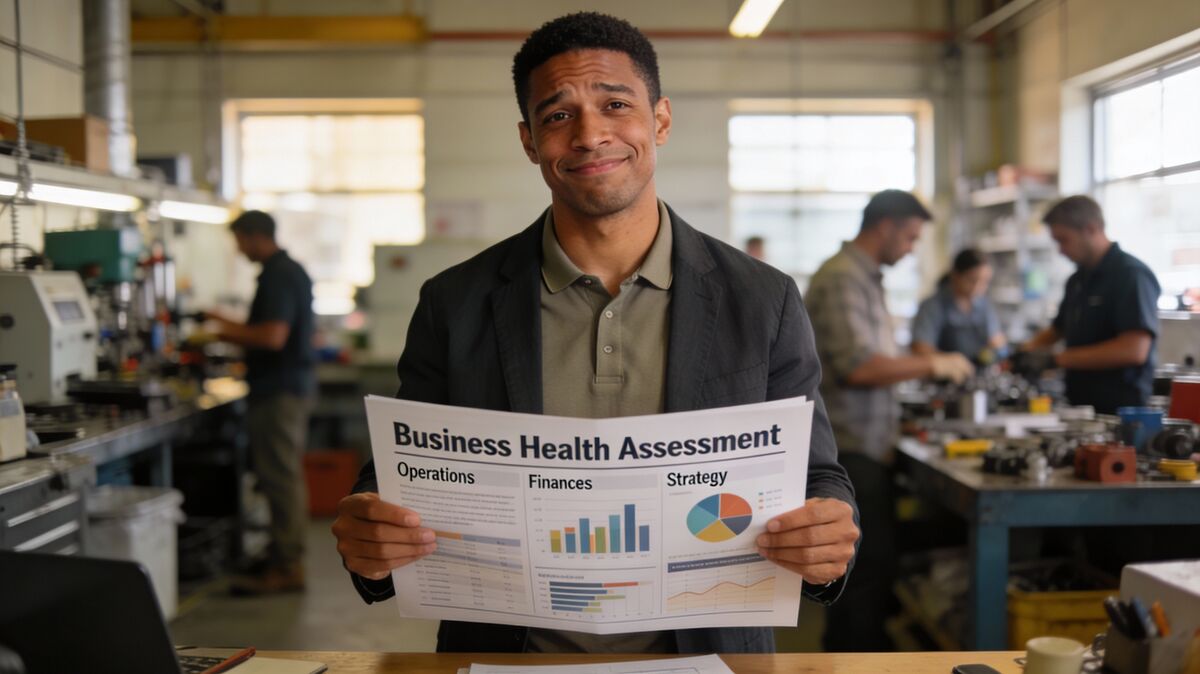
When crisis hits, you don't have time for lengthy consultant engagements. You need facts—now. A comprehensive business health assessment reveals critical gaps across finance, operations, staffing, customers, and strategy.
A 30-40 minute assessment can reveal:
Instead of spending weeks analyzing or getting conflicting opinions, you get facts and prioritization. You know what to focus on first. You know what you can stop worrying about. You know where to allocate limited resources.
In crisis, time is literally money.
Each week of delay costs real dollars and closes recovery options. The assessment that takes hours instead of weeks can be the difference between survival and failure.
When sharks are circling, panic is the enemy and delay is the killer. Stay emotionally calm, assess facts ruthlessly, prioritize strategically, and act with urgency.
The businesses that survive crises aren't the lucky ones or the ones with perfect situations. They're the ones that get clear about what's actually happening, focus limited resources on critical issues, and move decisively.
Assessment is not delay—it's the foundation of strategic action.
Get facts fast. Decide quickly. Act decisively.
That's how you survive when the sharks are in the water.
Need Facts Fast? Get Your Business Health Assessment
In 30-40 minutes, get a comprehensive view of your business across 12 critical dimensions. Know what to fix first. Stop guessing. Start acting strategically.
Get Your Assessment Now
BizHealth.ai Research Team
Business Health & Crisis Management Experts
The BizHealth.ai Research Team combines decades of experience in business turnarounds, crisis management, and operational excellence. We've helped hundreds of small businesses navigate challenging times and emerge stronger.