
In the competitive arena of 2025, small and mid-sized business leaders are facing a critical juncture. Industries like professional services, retail/e-commerce, manufacturing, tech startups, and healthcare demand rapid adaptation, but scaling small business operations often leads to unforeseen pitfalls. With 60% of small businesses stalling post-year three due to unchecked growth, the scaling paradox emerges: expansion that promises success can instead trigger cash squeezes, operational chaos, and burnout. This isn't mere theory—it's a reality for high-agency multitaskers seeking sustainable paths amid inflation and talent shortages.
At BizHealth.ai, we provide AI-driven diagnostics across 12 key areas to eliminate guesswork and affirm strengths. Our platform helps uncover blind spots in Strategy, Financials, and more, delivering 20x ROI on $199-$799 business health assessments. In this guide, we'll explore the shift to profitable scaling, decision-making frameworks for readiness, the 12 areas that fracture under pressure, real founder mistakes from Reddit and X, and scalable revenue models. Let's navigate small business growth strategy 2025 and business scaling challenges to turn potential pitfalls into resilient advancement.
The Shift from Growth-at-All-Costs to Profitable Scaling: Why Profitability Now Matters More Than Revenue Growth
The era of "growth at all costs" is waning for small businesses in 2025, as economic realities demand a pivot to profitable scaling. According to Gusto's State of Small Business 2025 report, while optimism persists with 9.7% projected growth over the decade, rising costs—cited by 46% as the top concern—force a reevaluation. This shift prioritizes margins over sheer revenue spikes, as unchecked expansion often leads to higher churn and resource strain.
Why the change? Inflation remains a macro challenge for 70% of small businesses per SBA, eroding profits from variable expenses like labor (up due to regulations) and supplies. CFO Brew highlights that companies are now balancing growth with profitability for long-term health, moving away from venture-fueled burn rates. For scaling small businesses, this means focusing on efficiency: 53% adopt AI for workflows, per SBA, to achieve 15-20% gains without proportional cost hikes.
Real-world X insights underscore this: industry leaders note that small business growth starts with people-side wins, like resilient teams amid volatility. In global markets like Canada (58% small business increase) or the UK (101% fastest growth), universal KPIs enable profitable scaling without major tweaks. BizHealth.ai's diagnostics reveal these shifts early, linking Financials gaps to BizGrowth courses for sustainable models.
Key Insight:
Profitability trumps revenue because it builds buffers: Target 3-6 months of expenses in reserves to weather stalls. As Clutch's 2025 Playbook advises, data-driven decisions turn challenges into catalysts, yielding 20x ROI. For ICP pains like cash constraints, this paradigm ensures growth without breaking.
Decision-Making Frameworks for Scale-Ready Businesses: How to Evaluate If Your Operations Can Handle 2x Growth
Before pursuing 2x growth, assess readiness with proven decision-making frameworks. These tools help evaluate if operations can scale without fracturing, addressing business scaling challenges head-on.
Essential Scaling Frameworks
The SCALE Framework from Phoenix Strategy Group offers a 5-step approach: Strategy alignment, Culture building, Automation integration, Leadership development, and Execution monitoring. Start by mapping core processes—can your tech stack handle doubled volume? Use questions like: "What's our capacity utilization?" If below 80%, you're primed; otherwise, optimize first.
RACI (Responsible, Accountable, Consulted, Informed) clarifies roles for scaling decisions, preventing bottlenecks in HR or ops. For 2x evaluation, assign RACI to key initiatives: If "Accountable" overlaps too much on founders, delegate to avoid overload.
RAPID (Recommend, Agree, Perform, Input, Decide) from Bain & Company streamlines complex choices, ideal for small businesses eyeing global expansion. Input from teams on "Can we double sales without doubling staff?" fosters buy-in.
McKinsey 7S Model examines Strategy, Structure, Systems, Shared Values, Style, Staff, and Skills for alignment. Rate each on a 1-5 scale—if averages below 4, pause growth.
Harvard's Six S Framework (Scope, Speed, Sequence, Stakes, Style, Shared Values) guides pacing. For small businesses, sequence tech upgrades before hiring.
BizHealth.ai integrates these: Our 30-min questionnaire evaluates 12 areas against 2x scenarios, auto-recommending fixes for 15-20% efficiency.
Scale Readiness Check
Is your business actually ready to scale?
60% of small businesses stall post-year three from unchecked growth. A quick health assessment evaluates your readiness across 12 critical areas—before scaling breaks what's working.
No consultants. No ongoing fees. Just clarity.
The 12 Critical Business Areas That Break During Rapid Scaling
Rapid scaling exposes vulnerabilities across 12 critical areas, per BizHealth.ai's diagnostics. Ignoring them leads to 60% post-year-3 stalls.
1. Finance
Cash flow crunches from unchecked expenses; monitor EBITDA dips.
Fix: AI forecasting for 20% gains
2. Operations
Bottlenecks in supply chains; inflation hits variables hardest.
Fix: Automation for efficiency
3. HR
Talent shortages amid growth; 4.8M manufacturing firms struggle with labor quality.
Fix: Culture audits
4. Technology
Outdated stacks fail under load; 53% AI adoption combats this.
Fix: Cloud upgrades
5. Strategy
Misaligned goals; use McKinsey 7S for cohesion.
Fix: 7S framework
6. Marketing
Overextended campaigns dilute ROI; focus on data-driven channels.
Fix: Accent-driven CTAs
7. Sales
Pipeline overload without automation; DSO rises.
Fix: Predictive analytics
8. Risk Management
Compliance lapses in expansion; global markets add volatility.
Fix: Compliance tools
9. Customer Service
Quality drops with volume; hybrid models help.
Fix: AI chatbots
10. Legal/Compliance
Regulatory hurdles in new markets like EU GDPR.
Fix: Global benchmarks
11. Innovation
Stifled by ops fires; allocate for R&D.
Fix: Dedicated budgets
12. Leadership
Founder burnout; develop teams for delegation.
Fix: Training hubs
Address these proactively for resilient small business growth strategy. Learn more about our comprehensive approach at How It Works.
Real Reddit Data: Common Mistakes from Founders Who Scaled Too Early
Founders often scale prematurely, leading to costly errors. Reddit threads reveal patterns: hiring before systems, chasing opportunities, tool overload.
In r/smallbusiness, users cite premature scaling as the top killer—founders ignore startup truths like validating fit first. One shared losing $1M on a SaaS that never launched due to untested assumptions.
r/startups echoes: Churning at 30-40% post-growth from unsubscribes; tool overload overwhelms founders juggling SaaS stacks. Hiring without processes leads to chaos, as in corporate-to-startup transitions where romanticized culture hides realities.
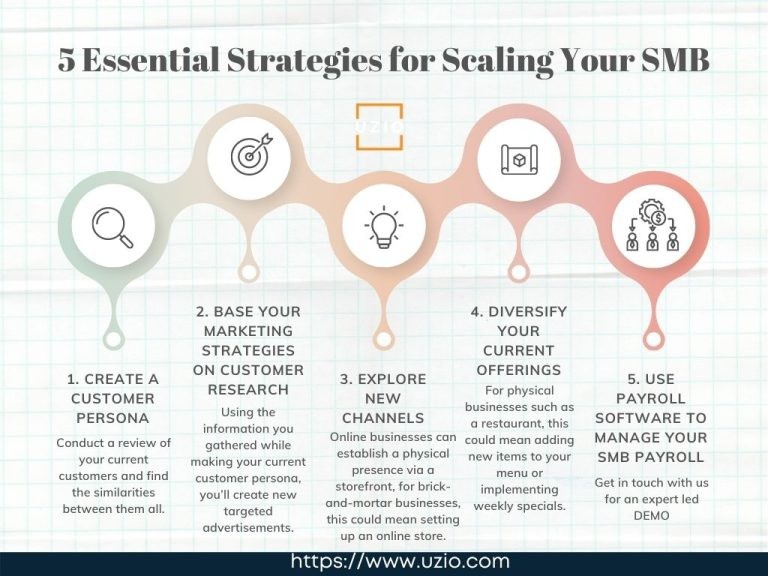
5 Essential Strategies for Scaling Your Small Business
1. Create a Customer Persona
Conduct a review of your current customers and find the similarities between them all. Using the information you gathered while making your current customer persona, you'll create new targeted advertisements.
2. Base Your Marketing Strategies on Customer Research
Leverage data-driven insights to inform your marketing decisions and improve targeting effectiveness.
3. Explore New Channels
Online businesses can establish a physical presence via a storefront, for brick-and-mortar businesses, this could mean setting up an online store.
4. Diversify Your Current Offerings
For physical businesses such as a restaurant, this could mean adding new items to your menu or implementing weekly specials.
5. Use Payroll Software to Manage Your Small Business Payroll
Streamline operations with automated systems that reduce administrative burden and improve accuracy.
Source: uzio.com
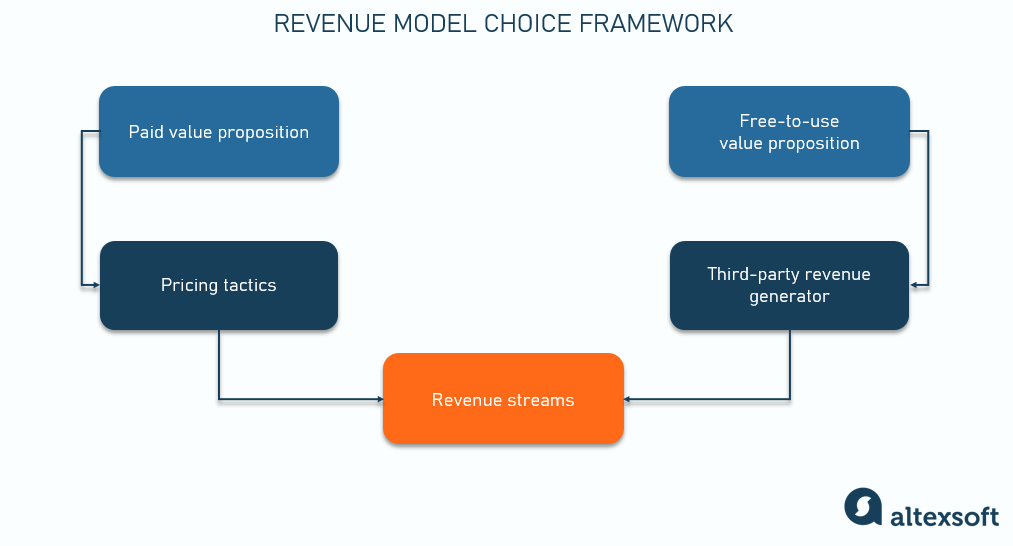
Scalable Revenue Models for Small Businesses
| Model | Pros | Cons | Best for Business Type | |
|---|---|---|---|---|
| Subscription | Predictable MRR, loyalty | Churn risk, fatigue | Services, SaaS | |
| One-Time | Quick cash, low commitment | Volatile, no recurrence | Retail, one-off tools | |
| Hybrid | Balance, upsell potential | Complex management | Startups, manufacturing |
Tailor to ICP: Subscriptions for ongoing health, hybrids for global markets with high need.
Conclusion: Stop Guessing, Start Growing
The small business scaling paradox demands profitable, assessed growth. By shifting mindsets, using frameworks, fortifying 12 areas, avoiding mistakes, and selecting revenue models, you can thrive in 2025 and beyond.
Ready to assess your business health and uncover blind spots before they become costly problems? Take the first step towards sustainable scaling with BizHealth.ai's comprehensive diagnostics.
Get Your Business Health Assessment Today
Discover your company's vital signs across 12 critical areas and get actionable insights to scale profitably. Our diagnostics provide a 20x ROI on assessments starting at just $199.