
Updated June 2026 — refreshed with the current small business operating environment.
In the grind of running a small or mid-sized business in 2026, you're likely no stranger to that nagging feeling: sales are uneven, costs are creeping up, and despite your best efforts, growth feels stalled. A common pattern emerges across small business communities: 60% of owners report being "down" year-over-year, yet most attribute it to "market conditions" or "the economy"—without digging into their own operations. Here's the paradox: as a small business leader you're too immersed in daily fires to spot the root causes. These hidden "business blind spots" aren't obvious; they're systemic gaps in finance, operations, talent, customer experience, and strategy that silently drain resources.
Source: The Business Research Company
The Psychology of Business Blind Spots
Blind spots aren't a sign of incompetence—they're a human condition amplified in high-stakes SMB environments. The proximity paradox is at play: as the founder who built the business from the ground up, you're so close to the day-to-day that systemic issues blend into the background. A LinkedIn post from a leadership coach captures it: "Exceptional people know their flaws, but many leaders hide weaknesses, creating trust erosion in teams." This false confidence trap leads organizations to invest heavily in visible areas like sales or marketing while ignoring foundational systems such as legal compliance or tech infrastructure.
For small & mid-size businesses, this is particularly acute. With limited resources, leaders wear multiple hats—CEO by day, accountant by night—creating overwhelm that masks gaps. Statista reports that 77% of SMBs lack deep AI understanding, often relying on gut feel, which exacerbates blind spots. The real-world consequence? Businesses that fail to identify constraints "by definition will not improve," as one Reddit user put it in a thread on operational inefficiencies. Statistically, 70% of SMBs face cash flow challenges, yet many blame external factors like "the market" rather than internal misalignments, per SBA benchmarks.
High-performing leaders are especially vulnerable because success breeds complacency. Gartner notes that 60% of SMBs stall post-year three due to unaddressed internal gaps, not market shifts. This "success blindness" means you're optimizing what you know while invisible leaks—like outdated processes costing 15-20% in productivity—go unchecked. HubSpot's 2026 report emphasizes that in inflation-hit environments, these psychological barriers prevent adoption of tools that could reveal hidden efficiencies.
To break the cycle, recognize that blind spots thrive in isolation. External perspectives—whether from peers on LinkedIn or AI diagnostics—are essential. As one X post states, "Leaders who acknowledge vulnerabilities build stronger teams." Understanding this psychology is the first step to turning hidden weaknesses into strategic advantages — and you don't have to hire an outside firm to start; our walkthrough on how to confirm your business weaknesses without consultants shows owners how to surface the same insights with a structured self-assessment.
The 5 Most Dangerous Blind Spots Killing SMB Growth
Blind spots aren't abstract—they're concrete issues eroding your bottom line. Here, we break down the five most dangerous, with diagnostic questions to self-assess. Each can cost $50K+ annually in lost productivity, revenue, or opportunities, based on average SMB revenues of $500K and 15-20% inefficiency drains.
Blind Spot #1: Financial Misalignment Beyond Cash Flow
Financial blind spots extend far beyond obvious cash crunches—they involve subtle profitability misjudgments and resource misallocations that silently bleed profits. While 70% of SMBs cite cash flow as a top challenge, many overlook how unprofitable customers or products exacerbate it.
What it looks like: Focusing on top-line growth while margins erode from rising costs or inefficient pricing. A Reddit user in r/smallbusiness shared, "Costs up, revenues down," but couldn't pinpoint which expenses were the culprits—a common tale where businesses track revenue but not customer acquisition cost (CAC) vs. lifetime value (LTV).
The hidden danger: Without baseline metrics, you might subsidize unprofitable segments, costing 10-15% of revenue. In 2026, with inflation as the top macro issue per BILL, this misalignment turns survivable dips into crises.
Diagnostic questions:
- Do you know your true profit margin by product/service?
- Can you identify which customers are unprofitable?
- If not, you're flying blind—tools like AI diagnostics can benchmark these against industry standards, revealing $50K+ in annual savings.
Blind Spot #2: Operational Inefficiencies & Process Bottlenecks
Operational blind spots manifest as "constant firefighting," where reactive fixes mask systemic inefficiencies. Legacy systems and data silos create 15-20% productivity drains, per Gartner efficiency reports.
What it looks like: Teams spending time on recurring issues, like manual invoicing delays or supply chain hiccups. Only 19% of small organizations conduct strategic IT planning, leading to wasted licenses and security gaps, as VikingCloud notes.
SMB-specific challenge: With limited staff, bottlenecks amplify—LinkedIn discussions highlight how "new systems, smarter processes" fail without addressing workflows. The danger is that inefficiencies compound, creating a cycle of reactive management that prevents strategic growth.
Blind Spot #3: Talent & Leadership Capability Gaps
Talent blind spots involve undetected skill deficits that bottleneck innovation and scaling. 61% of SMBs struggle to hire in 2026, but the real issue is missing capabilities in existing teams.
What it looks like: Hiring before systems are ready or lacking management depth for growth. Alignment problems prevent scaling—many can't match enterprise salaries but fail to leverage culture.
The hidden danger: Turnover costs 50-200% of salary, averaging $36,723 per employee.
Diagnostic questions:
- Do you have succession plans for key roles?
- Can your team handle 2x growth without breaking?
- Identifying these gaps early prevents costly exodus.
Blind Spot #4: Customer Experience Disconnect
Customer blind spots occur when you assume what customers value without validation. 83% of small businesses believe customer experience sets them apart, yet most can't identify undermining gaps.
What it looks like: Measuring satisfaction but ignoring churn reasons or retention cohorts. In 2026, consumers expect "better, faster" experiences, but SMBs fall short.
The danger: Lost customers cost $50K+ in revenue.
Diagnostic questions:
- When was the last lost customer survey?
- Do you know retention by cohort?
- These reveal disconnects for quick fixes.
Blind Spot #5: Strategic Drift & Misalignment
Strategic blind spots arise when daily ops obscure direction, leading to silo work. 60% of SMBs stall post-year 3 due to unevolved plans.
What it looks like: Initiatives not supporting objectives, outdated policies. LinkedIn insights: SMB to enterprise shift requires new playbooks.
The danger: Wasted efforts cost $50K+ in opportunity.
Diagnostic questions:
- Can employees articulate top priorities?
- Do KPIs measure what matters?
- Alignment turns drift into momentum.
Blind Spot Detector
What if your biggest blind spot is the one you can't see?
60% of small businesses stall after year three due to undetected gaps. A structured assessment surfaces the hidden issues silently draining your profits.
No consultants. No ongoing fees. Just clarity.
Blindspot Analysis Framework
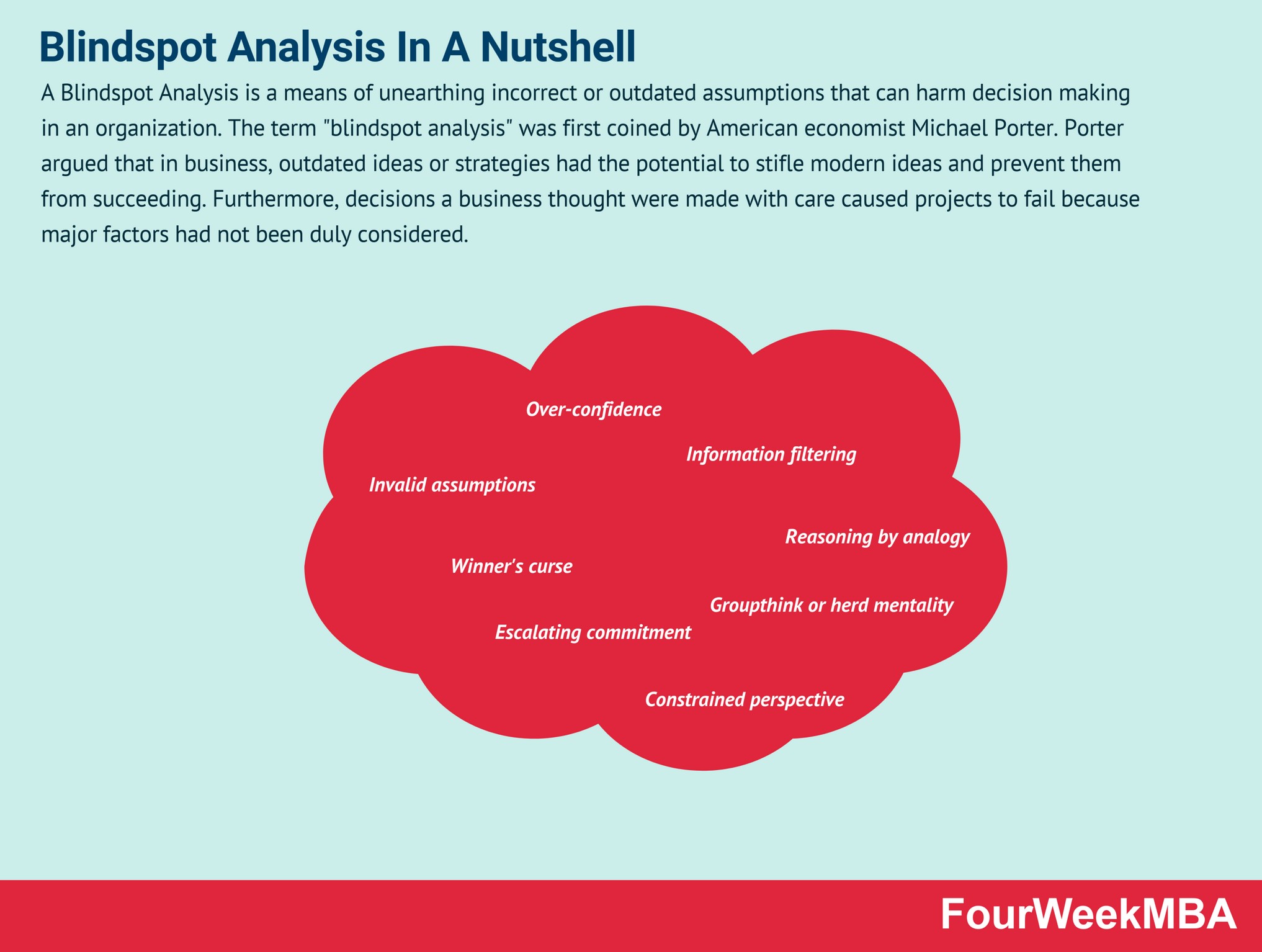
A Blindspot Analysis is a means of unearthing incorrect or outdated assumptions that can harm decision making in an organization. The term "blindspot analysis" was first coined by American economist Michael Porter. Porter argued that in business, outdated ideas or strategies had the potential to stifle modern ideas and prevent them from succeeding.
Common cognitive biases that create blind spots:
- Over-confidence
- Information filtering
- Invalid assumptions
- Winner's curse
- Reasoning by analogy
- Groupthink or herd mentality
- Escalating commitment
- Constrained perspective
Source: FourWeekMBA - Blindspot Analysis
Why Traditional Methods Fail to Expose Blind Spots
Traditional approaches—gut instinct, informal reviews—fall short because they reinforce biases. The consultant variability problem: Costs $10K+ with inconsistent results; different experts spot different issues. Internal reviews suffer confirmation bias, where teams see expected patterns.
Lack of baseline: 80% of failed businesses never knew health metrics pre-crisis. Data vs. intuition: LinkedIn shows gut-reliant founders struggle with AI due to skepticism without explainability. False security from metrics like revenue ignores comprehensive gaps. In 2026, with 53% AI adoption, traditional methods miss what unbiased diagnostics reveal.
Source: FourWeekMBA - Blindspot Analysis
The Framework for Uncovering What You Can't See
Uncover blind spots with this five-step framework:
Step 1: Conduct Holistic Business Analysis
Evaluate all dimensions using SWOT, McKinsey 7S, Balanced Scorecard. Must be unbiased—internal can't see own gaps.
Step 2: Gather Multi-Source Feedback
Employee insights on ops, customer data on behavior, external advisors for plain-sight issues.
Step 3: Benchmark Against Industry Standards
Compare KPIs; most SMBs lack peer context per Reddit.
Step 4: Prioritize Based on Impact & Urgency
Focus on vulnerabilities in cash-constrained settings; create roadmap.
Step 5: Establish Continuous Monitoring
Quarterly reassessments; build feedback loops.
This methodology turns unknowns into action, with AI accelerating discovery.
Source: ValueProp - The Johari Window
Real-World Consequences of Ignoring Blind Spots
Ignoring blind spots isn't benign—it's expensive:
- Financial drain: Inefficiencies cost 15-20% productivity, or $75K-$100K on $500K revenue.
- Competitive vulnerability: Competitors exploit your gaps.
- Scaling failures: 60% stall post-year 3 from bottlenecks.
- Security catastrophes: 94% of SMBs faced cyberattacks in 2024 (projected similar 2026), with breaches costing $4.24M average.
- Talent exodus: Turnover costs 50-200% salary, $36,723 per employee.
Reddit: Programs fail without addressing foundations.
From Blind Spots to Strategic Clarity
Reframe weaknesses as opportunities: Acknowledging builds trust, per LinkedIn. Exceptional leaders show struggles for stronger teams.
Growth requires constraint ID: Unwillingness blocks improvement.
Data-driven transformation: From reactive to proactive via baseline health. SMBs adapt 3x faster once identified.
Take the First Step
Awareness isn't action—knowing categories differs from spotting yours. Comprehensive assessment reveals gaps across 12 areas with benchmarks.
ROI: 15-20% gains yield 20-25x return.
View as due diligence: Diagnose before solutions. Urgency: Each quarter costs lost profit, opportunities.
Ready to uncover your business blind spots?
Get a comprehensive health assessment that reveals hidden gaps across finance, operations, talent, customer experience, and strategy.
Start Your BizHealth Assessment
About the Author
BizHealth.ai Research Team
Our research team analyzes thousands of small business data points, industry trends, and real-world founder experiences to provide actionable insights for SMB leaders. With expertise in business analytics, financial strategy, and operational excellence, we help entrepreneurs make data-driven decisions.
Related reading: Among the costliest of these are the cybersecurity blind spots most small business owners don’t see.